




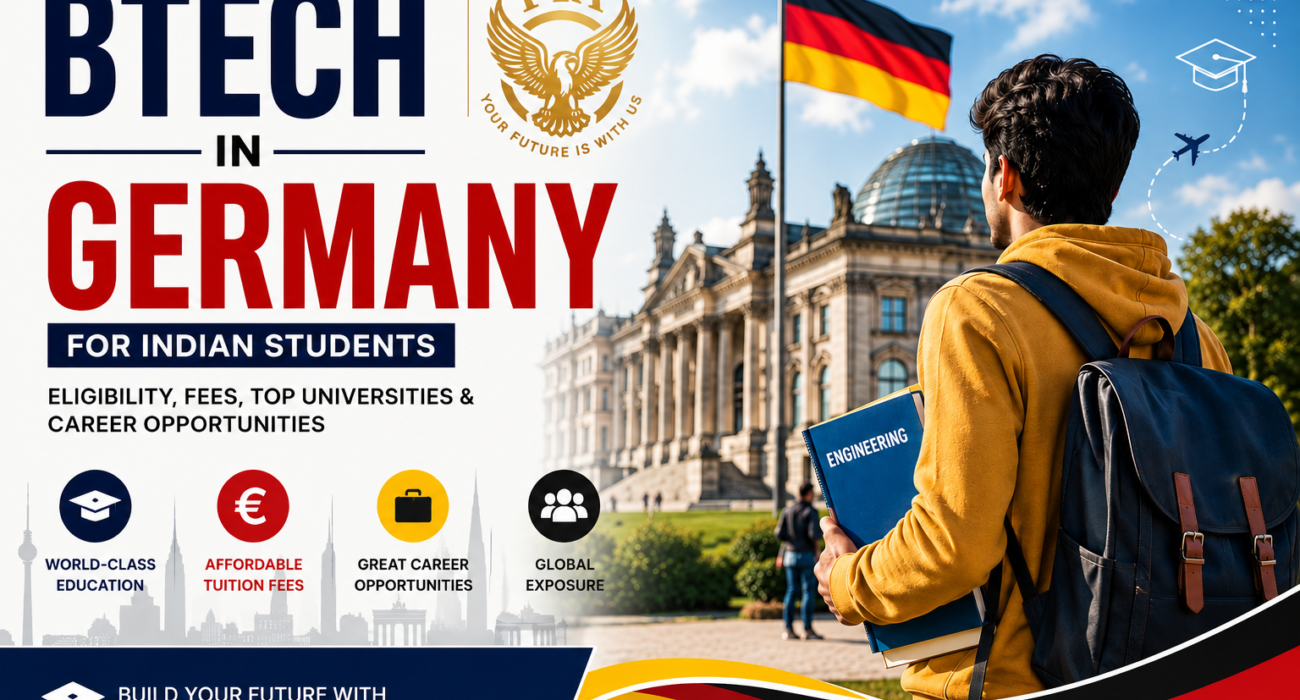

BTech in Germany for Indian Students: Eligibility, Fees, Top Universities & Career Opportunities
Introduction
Germany has become one of the most sought-after study destinations for Indian students pursuing engineering. Known for its world-class education system, affordable tuition fees, cutting-edge technology, and strong industrial sector, Germany offers excellent opportunities for students looking to build a successful engineering career.
While Germany does not offer a degree specifically called “BTech,” students can pursue equivalent undergraduate engineering programs such as Bachelor of Engineering (B.Eng.) and Bachelor of Science (B.Sc.) in various engineering disciplines.
This guide covers everything Indian students need to know about studying BTech in Germany, including eligibility requirements, tuition fees, top universities, scholarships, and career prospects.
Why Choose Germany for Engineering Studies?
multinational Germany is home to some of the world’s leading engineering institutions and companies. The country’s education system focuses on practical learning, research, and industry collaboration, making graduates highly employable.
Some major advantages include:
- Affordable or tuition-free education at public universities
- Globally recognized degrees
- High-quality engineering programs
- Strong job market for engineers
- Opportunities for internships and research
- Post-study work options
- Safe and student-friendly environment
Is BTech Available in Germany?
Unlike India, Germany does not typically use the term “BTech.” Instead, universities offer:
- Bachelor of Engineering (B.Eng.)
- Bachelor of Science (B.Sc.) in Engineering
These degrees are internationally recognized and considered equivalent to a BTech degree in India.
Popular Engineering Courses in Germany
Students can choose from a wide range of engineering specializations, including:

Mechanical Engineering
One of the most popular engineering disciplines in Germany due to the country’s strong manufacturing and automotive industries.
Computer Science and Software Engineering
Ideal for students interested in programming, artificial intelligence, cybersecurity, and data science.
Electrical Engineering
Focuses on electronics, power systems, telecommunications, and automation technologies.
Automotive Engineering
Germany is home to leading automobile manufacturers, making this specialization highly attractive.
Civil Engineering
Covers infrastructure development, construction management, and structural engineering.
Aerospace Engineering
Suitable for students interested in aircraft design, aviation technology, and space research.
Robotics and Mechatronics
Combines mechanical, electrical, and computer engineering principles to develop advanced automated systems.
Eligibility for BTech in Germany
Indian students must meet certain admission requirements before applying to German universities.
Academic Requirements
- Completion of Class 12 from a recognized board
- Strong performance in Mathematics, Physics, and Chemistry
- Minimum academic percentage as specified by the university
Language Requirements
For English-taught programs:
- IELTS score of 6.0–6.5 or higher
- TOEFL score as required by the institution
For German-taught programs:
- German language proficiency certificates such as TestDaF or DSH
Additional Documents
Applicants may need:
- Academic transcripts
- Statement of Purpose (SOP)
- Letters of Recommendation
- Updated resume or CV
- Passport copy
- Passport-sized photographs
Top Universities for Engineering in Germany
Technical University of Munich (TUM)
TUM is widely recognized for its engineering, technology, and innovation programs.
RWTH Aachen University
One of Europe’s leading technical universities with strong industry partnerships.
Karlsruhe Institute of Technology (KIT)
Known for advanced research and engineering excellence.
Technical University of Berlin
Offers diverse engineering programs with international exposure.
University of Stuttgart
Famous for automotive, aerospace, and mechanical engineering studies.
TU Dresden
Provides high-quality education and research opportunities in various engineering fields.
Tuition Fees for BTech in Germany
One of the biggest reasons students choose Germany is affordability.
Public Universities
Most public universities charge:
- No tuition fees or very low tuition fees
- Semester contribution fees ranging from €150 to €350
Private Universities
Private institutions may charge:
- €5,000 to €20,000 per year
Students should compare programs carefully before applying.
Cost of Living in Germany
Students should budget for monthly expenses such as:
Expense Estimated Monthly Cost
Accommodation | €300–€700 |
Food | €150–€300 |
Transportation | €50–€100 |
Health Insurance | €120–€150 |
Miscellaneous | €100–€250 |
The average monthly living cost ranges between €850 and €1,200.
Scholarships for Indian Students
Several scholarships help reduce the financial burden of studying abroad.
Popular options include:
- DAAD Scholarships
- Deutschlandstipendium
- Erasmus+ Scholarships
- University-specific merit scholarships
- Private foundation scholarships
Students should apply early as scholarship deadlines often close months before admission deadlines.

Engineering graduates are in high demand across Germany.
Popular industries include:
- Automotive Engineering
- Information Technology
- Artificial Intelligence
- Manufacturing
- Renewable Energy
- Aerospace
- Construction
- Robotics and Automation
Graduates can find opportunities with global companies such as BMW, Bosch, Siemens, Volkswagen, Mercedes-Benz, and SAP.
Average Salary After Graduation
Engineering graduates in Germany can earn competitive salaries.
Approximate annual salary ranges:
- Entry-level engineers: €45,000–€60,000
- Experienced engineers: €60,000–€90,000+
- Specialized engineering roles: €100,000+ in some sectors
Salaries vary depending on experience, specialization, and location.
How to Apply for BTech in Germany
Follow these steps:
- Research universities and engineering programs.
- Check eligibility requirements.
- Prepare language proficiency test scores.
- Gather academic documents.
- Submit applications through university portals or Uni-Assist.
- Apply for scholarships.
- Receive admission offer.
- Apply for a German student visa.
- Arrange accommodation and travel.
How Fly International Academy Can Help You Study BTech in Germany
Planning to study engineering in Germany can be a complex process, especially for students applying from India. From selecting the right university and preparing application documents to obtaining a student visa, each step requires careful planning and guidance.
Fly International Academy supports students throughout their study-abroad journey by providing expert counseling and personalized assistance. The academy helps students with:
- University and course selection
- Admission guidance
- Application processing
- Statement of Purpose (SOP) assistance
- Student visa support
- Scholarship guidance
- Pre-departure assistance
With experienced counselors and a student-focused approach, Fly International Academy aims to simplify the admission process and help aspiring engineers achieve their dream of studying in Germany.
Students interested in pursuing a BTech-equivalent engineering degree in Germany can benefit from professional guidance to make informed decisions about their academic and career goals.
Conclusion
Germany offers an excellent opportunity for Indian students seeking a high-quality engineering education at an affordable cost. With globally recognized degrees, strong industry connections, low tuition fees, and outstanding career opportunities, Germany continues to attract thousands of aspiring engineers every year.
If you are planning to study engineering abroad after Class 12, Germany should be at the top of your list. The combination of academic excellence, practical learning, and career growth makes it one of the best destinations for engineering education worldwide. For students seeking expert guidance throughout the admission process, Fly International Academy can provide valuable support in university selection, applications, visa processing, and study-abroad planning.